
New Year, New Map: DLCC’s 2026 Target Plan
What’s Real, What’s Marketing, and What It Means for the Rest of Us

January 1 is when everyone becomes a new person. We all say we’ll have new routines. Make new promises. And start our foot forward with “this is the year” energy.
In politics, it’s also when committees roll out the new map and dare you to believe it.
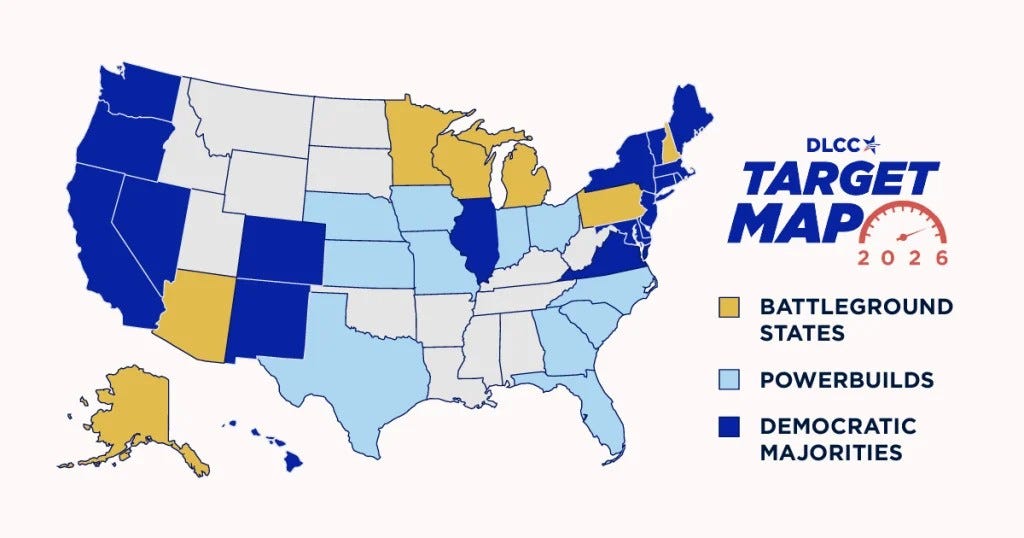
The DLCC just released its 2026 target plan and it’s a big swing. They’re invoking REDMAP, calling it a once-in-a-generation opening, and building a battlefield around the idea that state legislatures are where the country actually gets governed.
If you live in a battleground state, this reads like a battle plan. If you live in a red state, it can feel like a reminder that the national party’s attention has a zip code.
So let’s get run through what this is, what’s realistic, what’s a pitch, and why some states (hi, Tennessee) aren’t on the glossy map.
Quick explainer: DLCC is not the DNC
The DLCC is the Democratic Legislative Campaign Committee. Their lane is state legislatures. State House. State Senate. Majorities. Trifectas. Supermajorities. The machinery that decides whether your state protects workers or breaks unions, funds schools or hollows them out, expands Medicaid or lets hospitals close.
…They are not the DNC.
The DNC is the national party committee. Presidential infrastructure, national party operations…. A different lane.
So when DLCC drops a map, it is not “what Democrats care about.” It is what the state-leg power committee thinks is the best investment play for moving seats.
How DLCC actually operates (this is the part people miss)
DLCC doesn’t pick nominees. Primaries do.
They don’t run your county party. They don’t run your state party. They’re not a command center. They’re a committee that allocates money and support based on a simple but hard question: where can we move seats with the resources we have?… and that means triage.
Targets are not moral judgments. Committees look at margins, elasticity, candidate bench, local capacity, cost to communicate, and how close a chamber is to flipping or a supermajority is to breaking.
The closer the math, the more a dollar matters. The farther the math, the more you’re talking about a multi-cycle build.
Also, vocabulary for folks who don’t live on political Twitter:
Trifecta means governor + both chambers. That’s governing power.
Supermajority means veto-proof and often rule-changing power. Breaking one can matter almost as much as flipping a chamber.
Now we can talk about the 2026 pitch.
What DLCC is selling in 2026
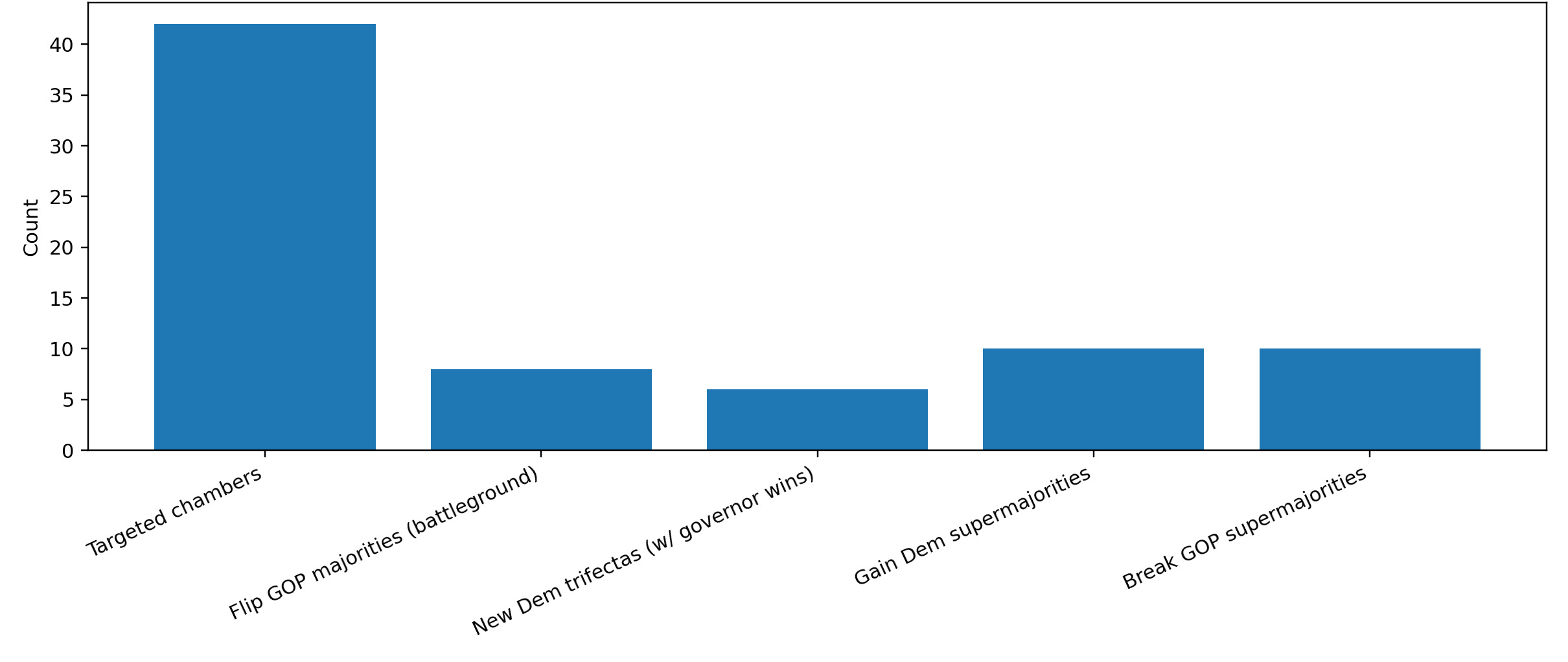
The big shift is that DLCC isn’t just selling flips this year. They’re selling “benchmarks of power.”
This map is framed as:
flipping key battleground chambers,
creating potential trifectas (if governors’ races line up),
gaining Democratic supermajories in some states,
breaking Republican supermajorities in others,
and generally “moving the board” even where a flip isn’t immediate.
That is either a smart evolution, or a fancy way to make a big map look inevitable.
What’s real on this map
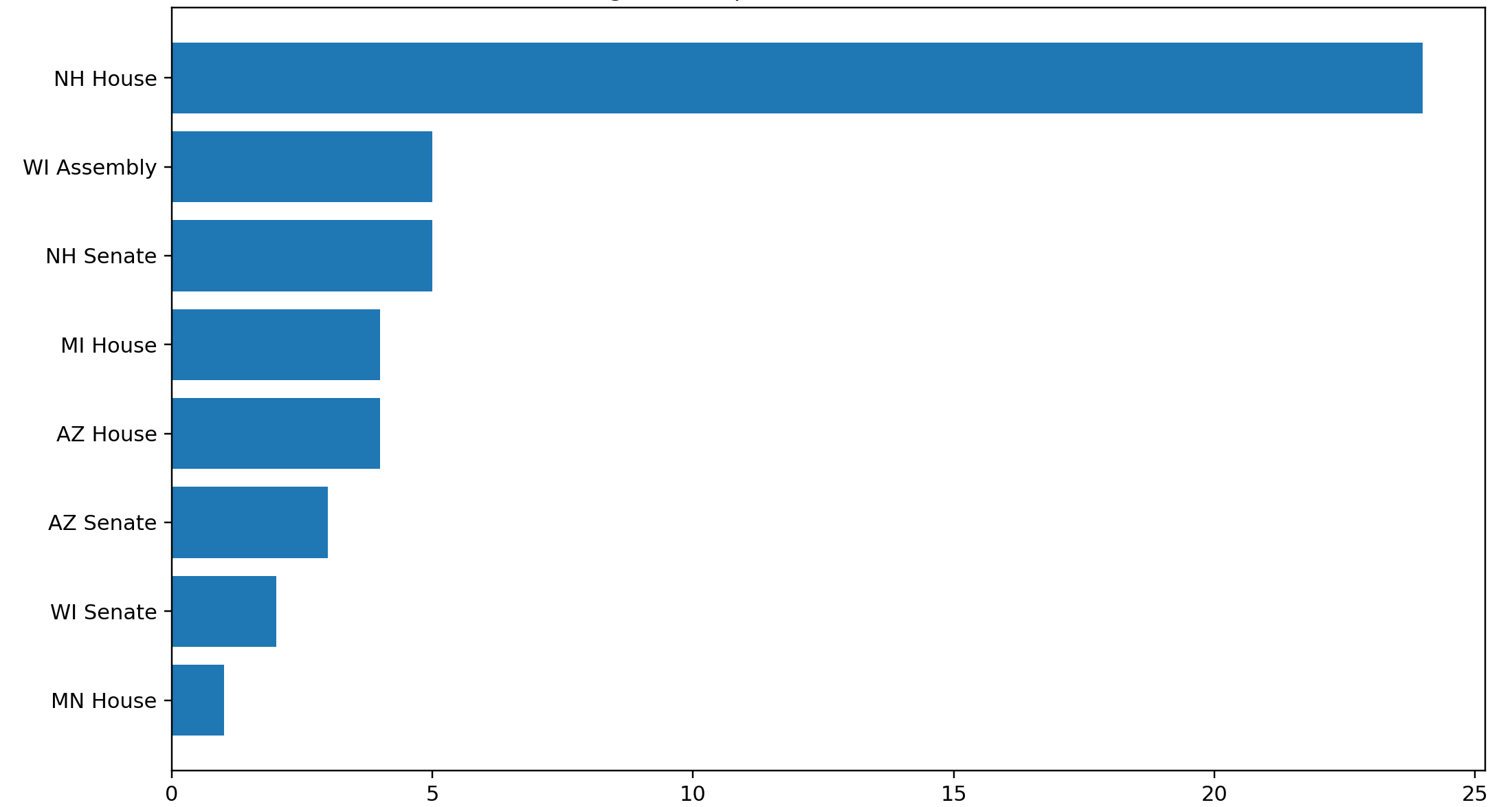
1) Battleground chamber control is real
In the battleground states, where chambers are within striking distance, state-leg races are absolutely winnable. That’s where candidate quality, field capacity, and early money actually change outcomes. This is all mechanical. And it moves numbers.
2) Breaking GOP supermajorities is the most serious category in the memo
This is the part I would take most seriously.
Supermajorities are how you get veto-proof power. It’s how you jam through extreme policy even when the public hates it, even when the governor hesitates, even when courts are the only check left.
Breaking a supermajority is often more achievable than flipping the entire chamber, and it can instantly change what’s possible in a state. If DLCC invests here with intent, it’s real leverage.
What’s marketing, or at least not explained

A big map can mean “we have more opportunities than ever.” It can also mean “we want everyone to feel included in the pitch.”
Forty-two chambers is a lot. The question is going to be concentration. How many of these get real early investment and how many get treated like a line item we will see in a fundraising email?
Because state-leg races aren’t won by late “feelings”. They’re won by capacity. And capacity is built early.
Also, “gaining supermajorities” can matter, but it often means already-blue states getting bluer. That is not the same value per dollar as flipping a battleground chamber or breaking a veto-proof GOP machine. Treating them as equal wins is how you end up celebrating the wrong scoreboard.
Why states like Tennessee isn’t on the map (and what that actually means)
Ready for a gut punch? Tennessee isn’t on the glossy map because Tennessee is a brutal short-term investment case if your metric is “can we flip the chamber in 2026.”
The margins are massive. The maps are ugly. Republicans aren’t just winning. They built a power structure designed to keep winning. Tennessee is not one cycle away. It’s multiple cycles of recruitment, local infrastructure, and bench building away.
That’s the pure hard math. But there is a part red-state folks need to hear: Tennessee not being on DLCC’s target list does not mean Tennessee does not matter.
It just means DLCC is choosing to spend money where it thinks it can show measurable seat movement in one cycle.
Those are different things.
If you live in states like Tennessee, the work still decides whether schools survive, whether hospitals close, whether libraries stay open, whether county commissions become MAGA playgrounds, whether public power gets privatized, whether voting access gets tightened, whether your community gets treated like an actual place to live.
The long game still decides the country. “Safe” red states are how Republicans build the floor that lets them gamble in battlegrounds.
The money reality (because nobody tells the truth about this)
A state House candidate raising $40,000 in a district that costs real money to communicate is not “competitive.” They’re a drain on scarce resources.
Because $40k is yard signs, a website, maybe a mail piece or two, and a lot of optimism. It is not enough paid communication to break through in the final month. It is not enough staff to run a real field plan.
What does “real” look like? It depends on the state and district, but roughly…
lower-cost districts: $75k–$150k can be a real campaign,
higher-cost suburban districts: $150k–$400k+ is not unusual once you factor staff, multiple mail drops, and digital,
top-tier battleground races can go beyond that.
Money isn’t everything. But pretending money doesn’t matter is how you lose on purpose.
And the second truth is that if you can’t raise enough to be heard, be honest about what you’re doing. Are you building infrastructure for the next cycle (legitimate), or are you running a performance campaign that soaks up donor oxygen and volunteer time from a race that could actually move power?
That’s triage. The right understands triage. We need to start acting like we do.
How to judge DLCC in 2026
Not by the map graphic. Judge them by behavior:
Where do they deploy staff, and how early?
Which states get real money early, not symbolic money late?
Do they strengthen local ecosystems or route around them?
Do they recruit candidates who match districts, not candidates who match Twitter?
Do they invest where breaking supermajorities changes real-life policy outcomes?
So, here’s what I’m not doing in 2026: I’m not clapping for a press release anymore.
I’m not getting high off the phrase “expanded map” while local parties are scraping together clipboards and printing lit at Staples. I’m not celebrating “benchmarks of power” while we keep funding performance campaigns that raise $40k, lose by 20, and then send a thank-you email like that was the plan.
Power is not a brand. Power is not a map. Power is the ability to make someone’s rent cheaper, their hospital stay shorter, their kid’s classroom better funded, and their vote harder to steal.
So if DLCC wants to invoke REDMAP, then act like you understand what REDMAP actually was: ruthless prioritization, early investment, and a decade-long obsession with seats, not speeches.
No more late money. No more consultant-first strategies. No more treating red and rural America like a punchline until it’s time to beg for turnout.
New year, new map. Prove it.
Happy New Year! to you and yours
—Chase